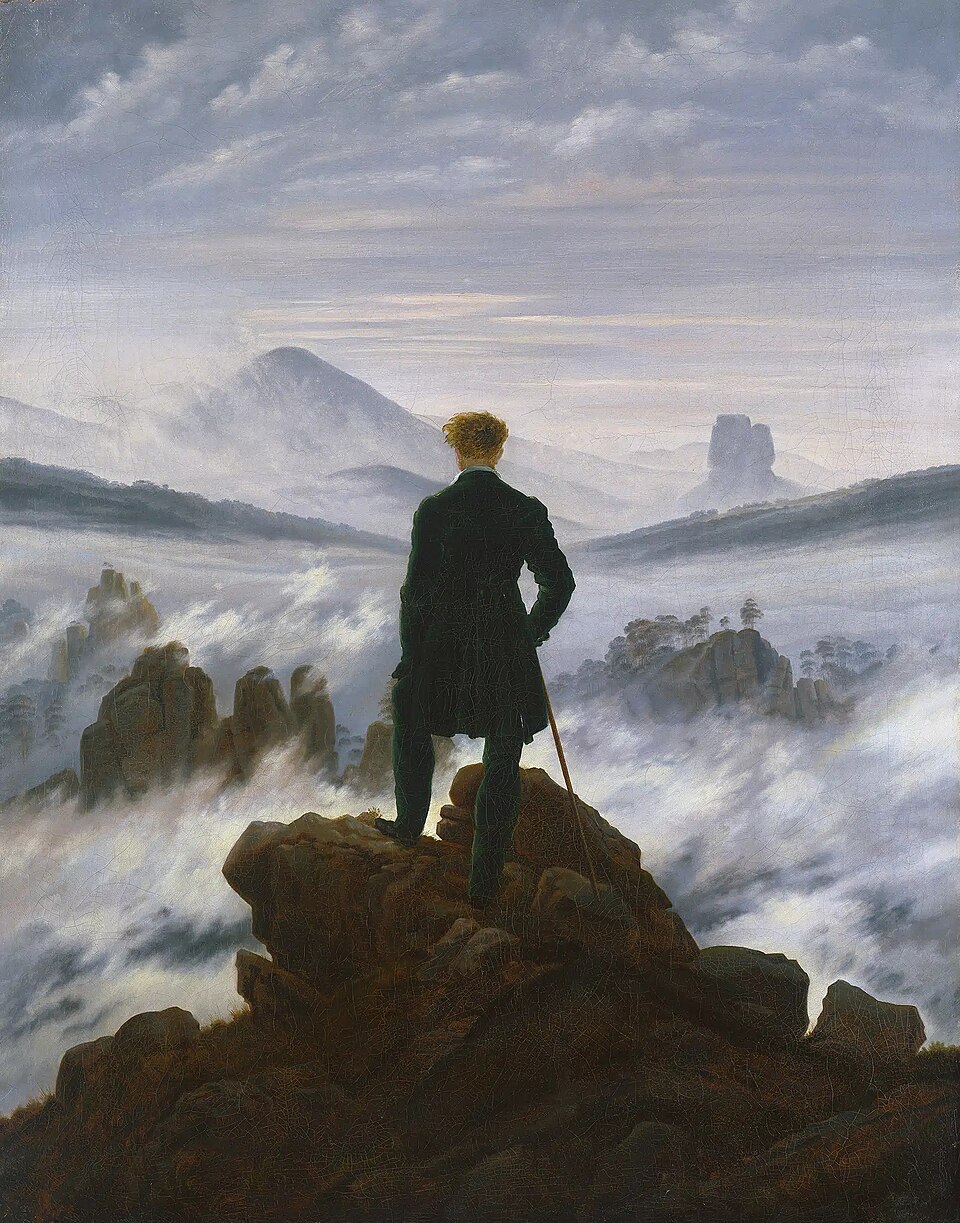
Caspar David Friedrich
Who
Born on 5 September 1774 in Greifswald, then in Swedish Pomerania, and dead in Dresden on 7 May 1840. A landscape painter who worked in Dresden; as a boy of thirteen he saw his younger brother fall through the ice of a frozen lake and drown. A stroke in June 1835 left him partly paralysed and able to paint little more.
Why they matter
He made landscape carry the weight of religion. His figures stand with their backs to us, facing fog, sea, ruins or the moon, so that we look with them rather than at them. When he put a landscape on an altar, the Tetschen Altar of 1808, the critic Basilius von Ramdohr objected that landscape painting should not sneak into the church. He died in relative obscurity, and his modern reputation dates from a Berlin exhibition of 1906 that showed thirty-two of his paintings.
What to buy
Prints: the Met sells Two Men Contemplating the Moon, its own version of the picture, made to order on paper or canvas, in the size and frame you choose. A reproduction from the museum that owns the painting is the one to trust. Many of his best-known pictures are in Hamburg, Berlin and Dresden, so for the Wanderer or The Sea of Ice you are choosing among general print sellers: look for a named source photograph and avoid anything cropped to fit a poster frame.
Books: Caspar David Friedrich. The Soul of Nature, the Met's catalogue for its 2025 exhibition, edited by Alison Hokanson and Joanna Sheers Seidenstein: a 296-page hardback with 154 illustrations, with contributions from Joseph Leo Koerner and Cordula Grewe. It covers the moonlit skies, Gothic ruins and figures seen from behind, and it is in print.
Originals: not realistic. The paintings are in museums, most of them German; a "Friedrich" offered at an ordinary sale or online is a copy or a follower's work, whatever the listing says.
Notes
The Hamburger Kunsthalle has the Wanderer above the Sea of Fog, which it dates to about 1817, and The Sea of Ice. Berlin's Alte Nationalgalerie has The Abbey in the Oakwood. The Met has the third Two Men Contemplating the Moon, acquired in 2000. More than 500 works are attributed to him.
Story
The Friedrich the Met acquired in 2000 is the third of three versions. The first, of 1819-20, is in Dresden; the second, around 1824, turned one of the two men into a woman and is in Berlin; the Met's dates from about 1825-30. One figure has often been identified as Friedrich himself and the other as his pupil August Heinrich, who died in 1822, so the first version was painted in Heinrich's lifetime and the second soon after his death. It looks like pure devotion - two Romantics lost in the moon - but when Friedrich showed the first version in his Dresden studio on 9 April 1820, his friend Karl Forster recorded him remarking, ironically, that the pair were plotting demagogic intrigues. The joke was political: both men wear the old-German costume that the authorities had suppressed. More than a century later the picture found a second life in the theatre. Samuel Beckett saw Friedrich's moon paintings on a journey through Germany in the 1930s, and years afterwards told the critic Ruby Cohn that the painting was a source of Waiting for Godot. Sources differ on which version he meant: one account has him saying it in front of the man-and-woman picture in Berlin.
Key works
- Cross in the Mountains (the Tetschen Altar) (1808)
- The Abbey in the Oakwood (1808-1810) - Alte Nationalgalerie, Berlin
- Wanderer above the Sea of Fog (c. 1817) - Hamburger Kunsthalle
- Two Men Contemplating the Moon (1819-1820) - Galerie Neue Meister, Dresden
- The Sea of Ice (1823-1824) - Hamburger Kunsthalle
- Two Men Contemplating the Moon (third version) (c. 1825-1830) - The Met, New York
In museum collections
- Tree of crows (1822)
Louvre ↗ · Find a print ↗ - Seashore with fisherman (1807)
Belvedere ↗ · Find a print ↗ - Seaside moonlight (1818)
Louvre ↗ · Find a print ↗ - Greifswald in moonlight (1817)
National Museum Norway ↗ · Find a print ↗ - Riesengebirge Landscape (1835)
National Museum Norway ↗ · Find a print ↗ - Sea beach in the fog (1807)
Belvedere ↗ · Find a print ↗ - Winter Landscape (1811)
Art UK ↗ · Find a print ↗ - Woman with a Raven at an Abyss (1803)
The Met ↗ · Find a print ↗ - Northern Landscape, Spring (1825)
National Gallery of Art ↗ · Find a print ↗ - Rocky ravine in the Elbe Sandstone Mountains (1822)
Belvedere ↗ · Find a print ↗ - Sketchbook (1800)
National Museum Norway ↗ · Find a print ↗ - Two men contemplating the Moon (1820)
The Met ↗ · Find a print ↗
See the work
Prints
Books
See also
Browse all 2,101 artists · Open in the directory · Where the work hangs: 58 museums on a map