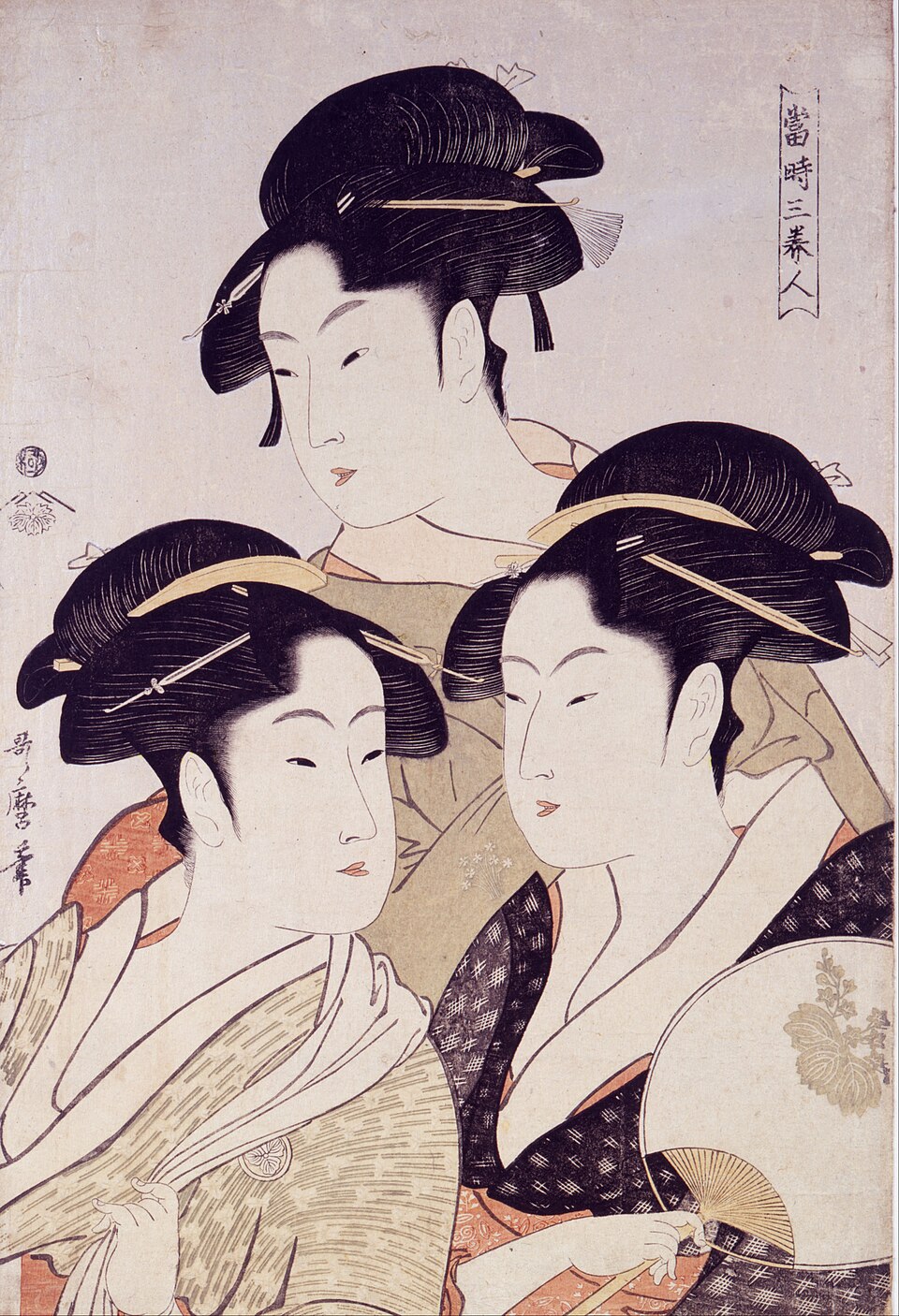
Kitagawa Utamaro
Who
Japanese ukiyo-e painter and print designer, born around 1753 as Kitagawa Ichitaro and dead in Edo in 1806. The publisher Tsutaya Juzaburo took him on around 1782, and he lived in Tsutaya's house for about five years while becoming the firm's principal artist.
Why they matter
He is the master of bijin-ga, pictures of beautiful women: close portraits of named celebrities of the day, a geisha and two teahouse waitresses in the Three Beauties, printed from a block per colour and dusted with mica so the background glitters. Europe learned ukiyo-e partly through him: Edmond de Goncourt's Outamaro of 1891 was the first monograph on the artist, and Monet, Degas and Toulouse-Lautrec collected his prints.
What to buy
Originals: Edo-period impressions do still come to market, so "original Utamaro" is a real category, but it is a specialist-dealer purchase. His earlier, most popular designs are hard to find in good condition, and copies have dogged him from the start: he sometimes signed "the genuine Utamaro" to separate himself from imitators. After Japan opened in the 1860s, European demand produced a wave of Meiji-era copies, many of them fine work that was never meant to deceive; but the Tokyo publisher Takamizawa Enji made both honest reproductions and deliberate fakes, "rejuvenating" worn old impressions by printing fresh colour over them on old paper. Treat any cheap "Edo original" as a copy until a dealer who puts their name to it says otherwise. The honest affordable tier is a twentieth-century or current hand-carved woodblock reproduction, sold as one: the Adachi Institute in Tokyo still cuts and prints them entirely by hand, and Fuji Arts lists woodblock reproductions of his designs. Prints: the Met, the Rijksmuseum and the Art Institute of Chicago publish their Utamaros as free, high-resolution open-access images, which beat anything a poster factory sells. Books: Asano Shugo and Timothy Clark's two-volume The Passionate Art of Kitagawa Utamaro (British Museum, 1995) is the standard catalogue, now out of print and found second-hand; Julie Nelson Davis's Utamaro and the Spectacle of Beauty is the readable modern monograph.
Notes
In 1804 he was punished for prints drawn from the Ehon Taikoki that showed the warlord Toyotomi Hideyoshi, named and wearing his crests, among courtesans: he was manacled for fifty days along with Toyokuni, Jippensha Ikku and others, and their publishers were heavily fined. He died two years later. Tsutaya, who published the insect book and the Three Beauties, had died in 1797, a loss said to have hurt the quality of Utamaro's later work. The Met holds the 1788 insect book, the MFA Boston an impression of the Three Beauties.
Story
Three of Utamaro's largest paintings, known together as Snow, Moon and Flowers, show the pleasure districts of Fukagawa, Shinagawa and the Yoshiwara. The oldest firm record of them is one day: 23 November 1879, when all three hung together at Joganji temple in Tochigi, north of Tokyo. They belonged to the local Zenno family, whose crest appears on garments in each picture. By the late 1880s they were in Paris, where the dealer Siegfried Bing tried to sell them to the British Museum. Instead they were dispersed. Charles Lang Freer bought the moon painting in 1903; the cherry blossoms went to the Wadsworth Atheneum in Hartford in 1957. Snow at Fukagawa was last shown in public at the Matsuzakaya department store in Tokyo in April 1948, and then disappeared for 66 years, until the new Okada Museum of Art in Hakone announced in 2014 that it had the painting. It has never said where the painting had been. Reuniting the set then ran into an older obstacle: Freer's will forbids lending any work in his collection, so the moon could not travel. The only place all three could hang side by side was Washington, and that is where they did, in the Sackler Gallery's Inventing Utamaro, from April to July 2017.
Key works
- Picture Book of Crawling Creatures (Ehon mushi erami) (1788) - The Met, New York
- Moonlight Revelry at Dozo Sagami (c. 1788) - Freer Gallery of Art, Washington
- Three Beauties of the Present Day (c. 1792-1793) - MFA Boston and others
- Cherry Blossoms at Yoshiwara (c. 1793) - Wadsworth Atheneum, Hartford
- Snow at Fukagawa (c. 1802-1806) - Okada Museum of Art, Hakone
In museum collections
- Gifts from the Ebb Tide (Shiohi no tsuto) (1789)
The Met ↗ · Find a print ↗ - Lovers in an upstairs room, from Uta makura ('Poem of the Pillow'), a colour woodblock print (1788)
British Museum ↗ · Find a print ↗ - Moon-Mad Monk (Kyōgetsubō) (1789)
The Met ↗ · Find a print ↗ - Selected Insects (Ehon mushi erami) (1788)
The Met ↗ · Find a print ↗ - Spring Colours
The Met ↗ · Find a print ↗ - The Young God Ebisu (Waka ebisu) (1789)
The Met ↗ · Find a print ↗ - A Courtesan
The Met ↗ · Find a print ↗ - Mother and Child (1790)
The Met ↗ · Find a print ↗ - A Pair of Lovers (1795)
The Met ↗ · Find a print ↗ - A Woman Playing with a Young Boy (1804)
The Met ↗ · Find a print ↗ - A Woman and a Cat (1790)
The Met ↗ · Find a print ↗ - Azumaya no Hana (1790)
The Met ↗ · Find a print ↗
See the work
Prints
Books
Originals
See also
Browse all 2,101 artists · Open in the directory · Where the work hangs: 34 museums on a map