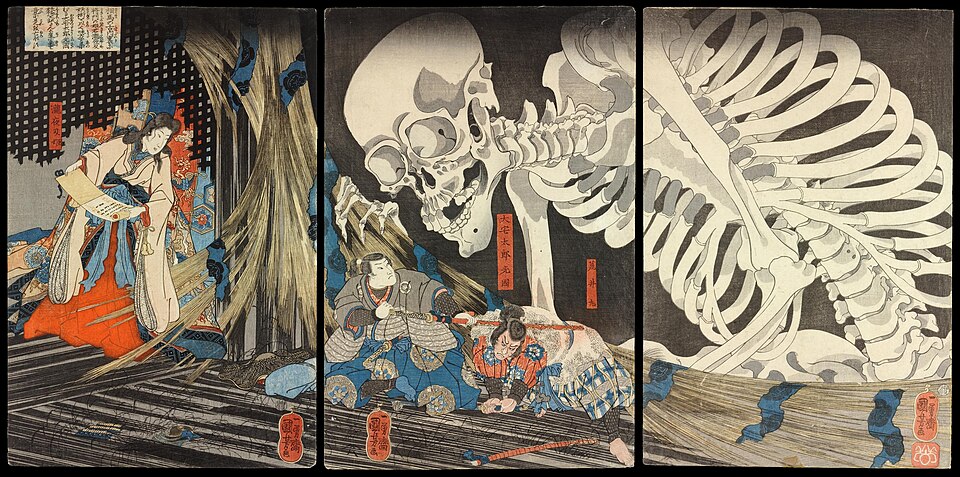
Utagawa Kuniyoshi
Who
Japanese ukiyo-e print designer and painter, born in Edo on 1 January 1798 and dead there in 1861. He entered the studio of Utagawa Toyokuni in 1811, took the name Kuniyoshi in 1814, and made his name with a warrior series commissioned in 1827.
Why they matter
He is the great designer of warriors, ghosts and monsters, known in his day as "Warrior Print Kuniyoshi", and he used the three-sheet triptych as one wide stage, as in the giant skeleton of Takiyasha the Witch. His Suikoden heroes, covered in tattoos, are bound up with the Edo taste for full-body tattooing. And he taught Tsukioka Yoshitoshi, now regarded as the last master of the Japanese woodblock print.
What to buy
Originals: this is where a collector can realistically own the real thing. Specialist dealers such as Fuji Arts sell Edo-period Kuniyoshi originals continuously. Single sheets from the warrior series and from the Forty-seven Ronin set of 1847-48 are the entry tier; famous designs and complete triptychs sit much higher. Condition decides value: faded colour, trimmed margins, repairs and a triptych missing a sheet all cut it hard, while fresh colour and full margins command a premium. Beware the copies: the Earth Spider triptych was pirated from recut blocks in its own year, so even a period sheet may not be the one Kuniyoshi and his publisher issued. Buy from a dealer whose description says plainly whether a sheet is an Edo-period impression, a pirate or a later reproduction. Prints: the museum open-access images are the best source for a wall print. Books: Timothy Clark's Kuniyoshi: From the Arthur R. Miller Collection (Royal Academy of Arts, 2009) is the best illustrated introduction; B. W. Robinson's Kuniyoshi: The Warrior-Prints (Phaidon, 1982) is the reference catalogue for the warrior prints, out of print and found second-hand.
Notes
Robinson's catalogue underpins the ordering of warrior prints on the Kuniyoshi Project website, the fullest online listing of his prints. The British Museum holds the Takiyasha triptych; the Honolulu Museum of Art and the Ukiyo-e Museum in Kurashiki hold other impressions. He loved cats, and put them in place of human actors in kabuki and satirical prints.
Story
In 1843, at the height of the Tenpo reforms, which had put prints of actors and courtesans off limits, Kuniyoshi published a triptych of an old Noh legend. The warrior Minamoto no Yorimitsu lies ill in the background while an earth spider conjures a procession of demons and ghosts; in front, two of his bodyguards sit playing go. Edo read it as a riddle picture. The sickly Yorimitsu was the shogun Tokugawa Ieyoshi, his retainers the ministers pushing the reforms, and each demon a group of people the reforms were grinding down. The print was a runaway success, and that frightened its publisher, Ibaya Senzaburo. Fearing punishment, he recalled the stock and destroyed the blocks in the eighth month of 1843. As it turned out, neither he nor the artist was punished. Suppression only made the image more wanted: two pirate editions were printed from completely recut blocks, each differing from the original in its details. Kuniyoshi carried on by other routes. With actors and courtesans banned, he made comic pictures that disguised them, and kabuki scenes played by cats.
Key works
- One Hundred and Eight Heroes of the Popular Suikoden (from 1827) - series
- The Earth Spider Conjures Up Demons at the Mansion of Minamoto no Raiko (1843) - V&A, London
- Takiyasha the Witch and the Skeleton Spectre (c. 1844) - British Museum, London
- Stories of the True Loyalty of the Faithful Samurai (1847-1848) - series
- Cats Suggested as the Fifty-three Stations of the Tokaido (c. 1847-1850) - Rijksmuseum, Amsterdam
In museum collections
- Head of a Courtesan
Harvard Art Museums ↗ · Find a print ↗ - Lady-in-Waiting at Edo Castle (1857)
The Met ↗ · Find a print ↗ - Recovering the Stolen Jewel from the Palace of the Dragon King (1853)
The Met ↗ · Find a print ↗ - Three Beauties Playing Musical Instruments (1830)
The Met ↗ · Find a print ↗
See the work
Prints
Books
Originals
See also
Browse all 2,101 artists · Open in the directory · Where the work hangs: 41 museums on a map