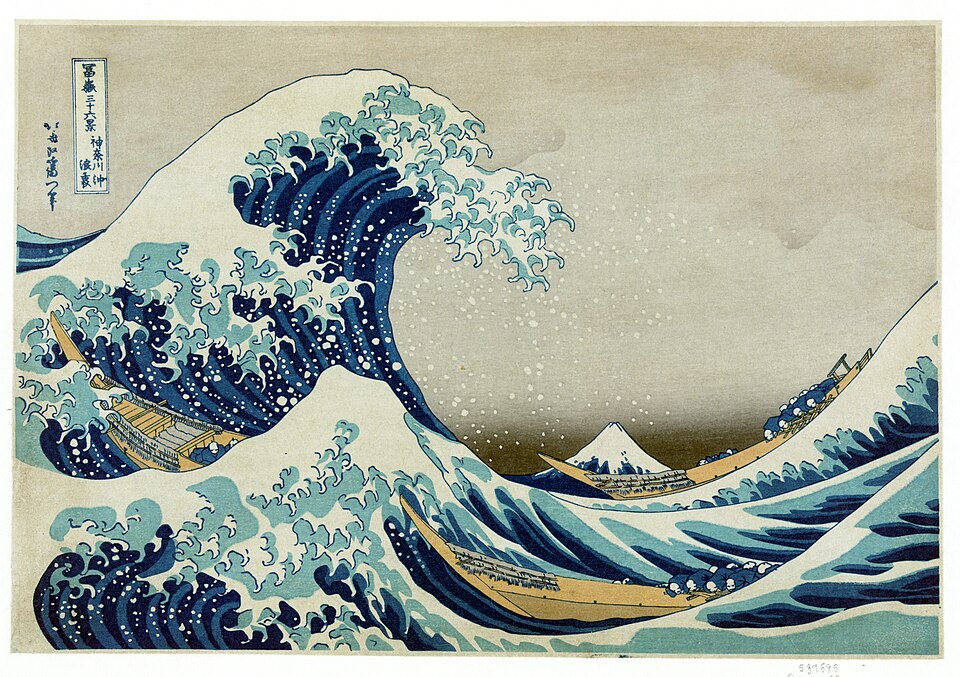
Katsushika Hokusai
Who
Japanese ukiyo-e painter and printmaker, active for seventy years under some thirty different names. The Thirty-six Views of Mount Fuji, published around 1830-32, contains the most reproduced image in the history of art.
Why they matter
The Great Wave arrived in Europe in the 1860s and changed Monet, Van Gogh, Debussy and the whole of Art Nouveau. Hokusai's fifteen volumes of Manga are the ancestor of every drawing manual and of the medium that now carries the name.
What to buy
Originals: woodblock prints are multiples, so "original Hokusai" is a real category, but the blocks for the Great Wave were used until they wore out and the image was recut and reprinted continuously from the Meiji period onward. Edo-period impressions run from the tens of thousands to over a million dollars. Most "original" listings on eBay are twentieth-century reprints from recut blocks, which are perfectly honest woodblock prints at 50-300 dollars as long as they are described that way. Buy from a specialist dealer for anything claimed to be early. Prints: the Met's own reproduction of its Great Wave impression is the cheap, correct choice. Books: Taschen's Thirty-six Views reproduces every print at full size.
Notes
The Met, the British Museum and the MFA Boston hold major impressions and publish them at high resolution.
Story
Hokusai was about seventy when the Great Wave was printed, and by his own account only just getting going. In the postscript to One Hundred Views of Mount Fuji (1834) he wrote that nothing he had drawn before the age of seventy was worth counting, that at seventy-three he had begun to grasp the structure of birds, animals, insects and fish, and that if he reached a hundred and ten every dot and line would be alive. He signed that book Gakyo Rojin Manji, "the old man mad about painting". The deep blue of the wave is Prussian blue, a synthetic pigment recently imported from Europe and cheap enough for a mass-market print: the most Japanese picture in the world depends on a Berlin chemistry accident of 1706. He died at 88, reportedly asking for five more years.
Key works
- The Great Wave off Kanagawa (c. 1831) - from Thirty-six Views of Mount Fuji
- Fine Wind, Clear Morning (Red Fuji) (c. 1831) - from Thirty-six Views of Mount Fuji
- Hokusai Manga (1814-1878) - 15 volumes of sketches
- A Tour of Waterfalls in Various Provinces (c. 1833)
In museum collections
- The Great Wave off Kanagawa (1830)
The Met ↗ · Art Institute of Chicago ↗ · LACMA ↗ · Find a print ↗ - A Picture Book on the Communication of Home Precepts (Ehon teikin ōrai)
The Met ↗ · Find a print ↗ - Brocade Prints of the Thirty-six Poetesses (1801)
The Met ↗ · Find a print ↗ - Mixed Verses on Jōruri (Ehon jōruri zekku) (1815)
The Met ↗ · Find a print ↗ - New Year's Day at the Ogiya Seiro (1804)
The Met ↗ · Find a print ↗ - Old Manji’s Cursive Picture Album (Manji-ō sōhitsu gafu) (1843)
The Met ↗ · Find a print ↗ - Picture Book of The Kōkyō (Ehon kōkyō) (1850)
The Met ↗ · Find a print ↗ - Picture Book of the Suikoden (The Water Margin) Loyalty (Chūgi Suikoden ehon) (1829)
The Met ↗ · Find a print ↗ - Picture Book on the Use of Coloring (Ehon saishikitsū) (1848)
The Met ↗ · Find a print ↗ - Sketches by Hokusai (Hokusai soga) (1820)
The Met ↗ · Find a print ↗ - The Life of Shakyamuni Illustrated (Shaka goichidaiki zue) (1845)
The Met ↗ · Find a print ↗ - The Story of Aoto Fujitsuna (1811)
The Met ↗ · Find a print ↗
See the work
Prints
Books
Originals
See also
Browse all 2,101 artists · Open in the directory · Where the work hangs: 51 museums on a map