Suzuki Harunobu
Who
Japanese ukiyo-e print designer who worked in Edo and died in 1770. Between 1765 and 1770 he made more than a thousand colour prints and over twenty illustrated books, mostly of young women and lovers, often recasting classical poems and legends in everyday settings.
Why they matter
He is the first great artist of the full-colour woodblock print, nishiki-e or "brocade pictures", in which a separate block is cut for each colour, up to ten on one sheet. The technique was worked out in 1765 for privately commissioned calendar prints, and every Japanese colour print after him, Hokusai and Hiroshige included, rests on it.
What to buy
Originals: genuine Harunobu prints do come to auction and to the specialist dealers, but they are rare, and they rarely look like the museum photographs. His colours were mostly vegetable pigments that fade easily, so most survivors are faded to browns, yellows and greens, on thin, soft paper. A sheet with fresh, bright colour on thick, new-looking paper is probably a later reproduction printed from newly cut blocks in modern dyes that do not fade. The other trap is period: his imitator Harushige, later famous as Shiba Kokan, put Harunobu's signature on his own prints after the master's death. Buy only from a dealer who says plainly whether a sheet is an original and what state the colour is in. Prints: a good reproduction of a well-preserved museum impression shows the colours that a faded original has lost. Books: David Waterhouse's The Harunobu Decade (Brill/Hotei, 2013) catalogues the Museum of Fine Arts, Boston collection, 721 prints of which 589 are by Harunobu himself. It is the reference, large and expensive; look for it second-hand.
Notes
The Museum of Fine Arts, Boston holds the largest and richest collection of Harunobu's work. The Art Institute of Chicago, the Met and the Rijksmuseum all show substantial holdings online.
Story
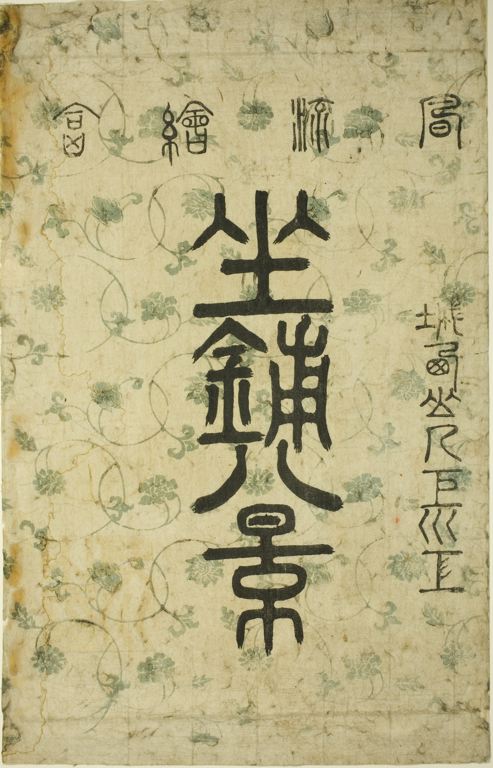
In 1765 a group of wealthy amateurs in Edo, led by the samurai poet Kyosen, Okubo Tadanobu, began commissioning picture calendars to swap at their gatherings. The Japanese lunar calendar changed every year, and the game was to hide that year's long and short months inside the composition for friends to find. Harunobu was hired to design them, and to make them lavish the printers cut a separate block for every colour. These were the first full-colour Japanese prints. Kyosen then commissioned the Eight Views of the Parlor, a domestic parody of the classic Chinese landscape set, issued with his own seal in paulownia boxes. The publisher Shokakudo reissued the same designs to the public with Kyosen's seal removed and Harunobu's name on the wrapper, and sold them as Azuma nishiki-e, brocade pictures of the Eastern Capital. A private game had become a commercial product. Harunobu died in 1770. Afterwards an imitator who signed himself Harushige put the master's signature on his own prints, which were accepted as genuine at the time, and he is said to have boasted how well he could forge him. Scholars now spot the fakes by the handwriting of the signature and the Western-style perspective. The forger is better known today as Shiba Kokan, famous for his Western-style paintings.
Key works
- A Young Woman in a Summer Shower (1765) - Art Institute of Chicago
- Eight Views of the Parlor (Zashiki hakkei) (c. 1766) - series
- Night Rain at the Double-Shelf Stand, from Eight Views of the Parlor (c. 1766) - The Met, New York
- The Evening Bell of the Clock, from Eight Views of the Parlor (c. 1766) - Art Institute of Chicago
- Beauty Under an Umbrella in the Snow (c. 1770) - Art Institute of Chicago
In museum collections
- Autumn Moon at the Temple Ishiyamadera
LACMA ↗ · Find a print ↗ - By the Sea (1760)
Finnish National Gallery ↗ · Find a print ↗ - Forty-eight Instructive Poems in Alphabetical Order (1788)
The Met ↗ · Find a print ↗ - Picture Book of the Eternal Pines (1767)
The Met ↗ · Find a print ↗ - Whispering (1767)
The Met ↗ · Find a print ↗ - A Girl Writing a Letter (1767)
The Met ↗ · Find a print ↗ - A Woman Sweeping up Her Love Letters (1750)
The Met ↗ · Find a print ↗ - A Young Woman Seated upon the Engawa of a House (1765)
The Met ↗ · Find a print ↗ - Blowing Soap Bubbles Under the Plum Blossom
The Met ↗ · Find a print ↗ - Combing His Hair (1770)
The Met ↗ · Find a print ↗ - Courtesan and Shinzō (1750)
The Met ↗ · Find a print ↗ - Daikoku Dōagé (1766)
The Met ↗ · Find a print ↗
See the work
Prints
Books
Originals
See also
Browse all 2,101 artists · Open in the directory · Where the work hangs: 27 museums on a map