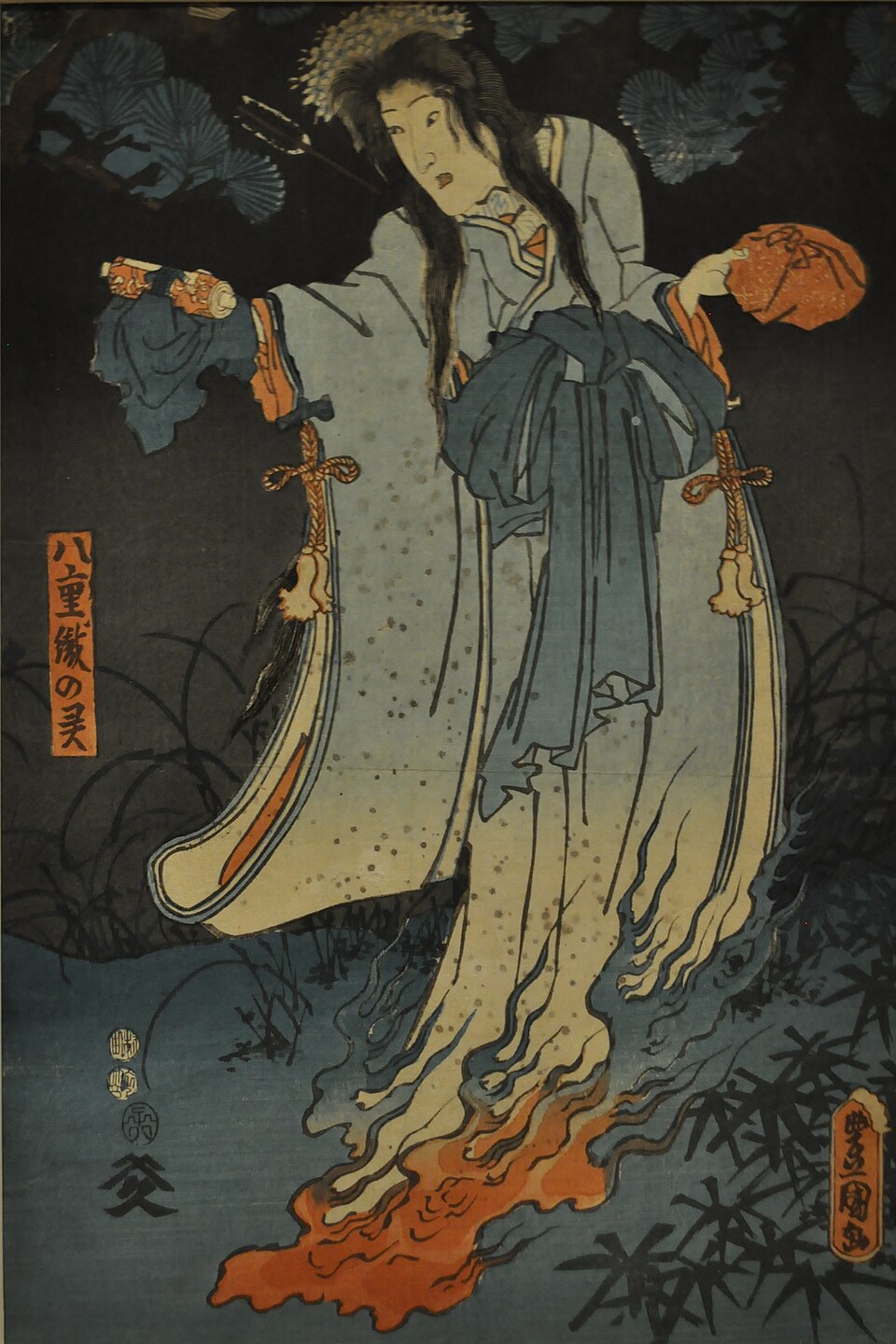
Utagawa Kunisada
Who
Japanese ukiyo-e print designer, born in Honjo, Edo, in 1786 and dead in 1865. A pupil of Utagawa Toyokuni from about 1800, he signed Kunisada until 1844 and then took his master's name, Toyokuni. About 14,500 of his designs have been catalogued, and estimates of his lifetime output run to twenty thousand or more.
Why they matter
He was one of the most popular and the most prolific print designers of his age: roughly six in ten of his prints show kabuki actors, he dominated sumo prints for forty years, and from 1835 to 1850 he held a near monopoly on prints from the Tale of Genji. Western critics dismissed him for most of the twentieth century; since the scholarship of the early 1990s he has been counted among the giants of the Japanese print.
What to buy
Originals: Kunisada is the easiest great name in Japanese prints to own in the original. He produced so much that genuine sheets are always on the market, and single actor prints are the entry tier, widely available and generally affordable. Complete triptychs and the narrative series such as the Genji and Tokaido prints cost more. Because genuine sheets are plentiful and affordable, his prints are less often faked than those of the rarer masters; what you need to judge is condition and impression. Faded colour, trimmed margins, worn later printings and a triptych missing a sheet all lower the value, while fresh colour and clean paper raise it. Signatures date a sheet: "Kunisada" before 1844, "Toyokuni" after, with "Kunisada changing to Toyokuni II" on prints of 1844-45. Prints: the Art Institute of Chicago and the Met show large holdings online that make good sources for a wall print. Books: Sebastian Izzard's Kunisada's World (Japan Society, New York, 1993), an exhibition catalogue with essays that illustrates more than a hundred of his designs, is the book that helped begin his rehabilitation; look for it second-hand.
Notes
The British Museum, the Met, the Museum of Fine Arts, Boston and LACMA all hold large collections. From the mid-1840s he collaborated with Hiroshige and Kuniyoshi on several series, partly as a show of solidarity against the censorship of the Tenpo Reforms; the best known is the Two Brushes Tokaido of 1854-57, Hiroshige's landscapes above his figures.
Story
Kunisada's family held a small hereditary licence to run a ferry in Edo, and the income let him take up painting. He joined the studio of Utagawa Toyokuni, and by 1813 a list of the city's most important print designers put him second only to his own master. When Toyokuni died in 1825, the master's son-in-law Toyoshige took the name Toyokuni. Toyoshige died in 1835, and in 1844 Kunisada finally took the name himself, announcing the change on prints signed "Kunisada changing to Toyokuni II", as if Toyoshige had never held it. History overruled him: today Toyoshige is Toyokuni II, and Kunisada is catalogued as Toyokuni III, a number he never used. His reputation had a second reversal after his death. In 1915 the critic Arthur Davison Ficke called him "this very undistinguished artist" and wrote that "all that meaningless complexity of design, coarseness of colour, and carelessness of printing which we associate with the final ruin of the art of colour-prints finds full expression with him." That verdict held for most of the century, until studies in the early 1990s by Jan van Doesburg and Sebastian Izzard changed the picture.
Key works
- Guan Yu, Liu Bei, and Zhang Fei (1825) - Art Institute of Chicago
- Landscape in Mist (c. 1832) - Art Institute of Chicago
- Viewing Maple Trees (1835) - Art Institute of Chicago
- Fifty-three Stations of the Tokaido Road (Two Brushes, with Hiroshige) (1854-1857) - series
- Memorial Portrait of Utagawa Hiroshige (1858) - Art Institute of Chicago
In museum collections
- Boy's Festival
Minneapolis Institute of Art ↗ · Find a print ↗ - Danjūrō VII's Benkei as Fudō Myōō (1824)
The Met ↗ · Find a print ↗ - Memorial Portrait of Iwai Hanshirō VI (1836)
The Met ↗ · Find a print ↗ - Memorial Portrait of the Actor Ichikawa Ōmezō I (1845)
The Met ↗ · Find a print ↗ - Ichikawa Danjūrō VII in a Shibaraku Role Confronting the Catfish Priest
The Met ↗ · Find a print ↗ - Kabuki Actor with a Fan (1820)
National Gallery of Art ↗ · Find a print ↗ - Scene from a Kabuki Play [center panel of triptych] (1840)
National Gallery of Art ↗ · Find a print ↗ - Scene from a Kabuki Play [left panel of triptych] (1840)
National Gallery of Art ↗ · Find a print ↗ - Scene from a Kabuki Play [right panel of triptych] (1840)
National Gallery of Art ↗ · Find a print ↗ - Scene from a Kabuki Play [triptych] (1840)
National Gallery of Art ↗ · Find a print ↗ - Untitled (1900)
National Gallery of Art ↗ · Find a print ↗
See the work
Prints
Books
Originals
See also
Browse all 2,101 artists · Open in the directory · Where the work hangs: 39 museums on a map