Keisai Eisen
Who
Japanese ukiyo-e print designer, born in Edo in 1790 into a samurai family and dead in 1848. His father was a Kano-school painter and calligrapher; after his death Eisen studied with the beauty-print master Kikugawa Eizan. He designed prints of women, landscapes, surimono and erotic prints, and also wrote.
Why they matter
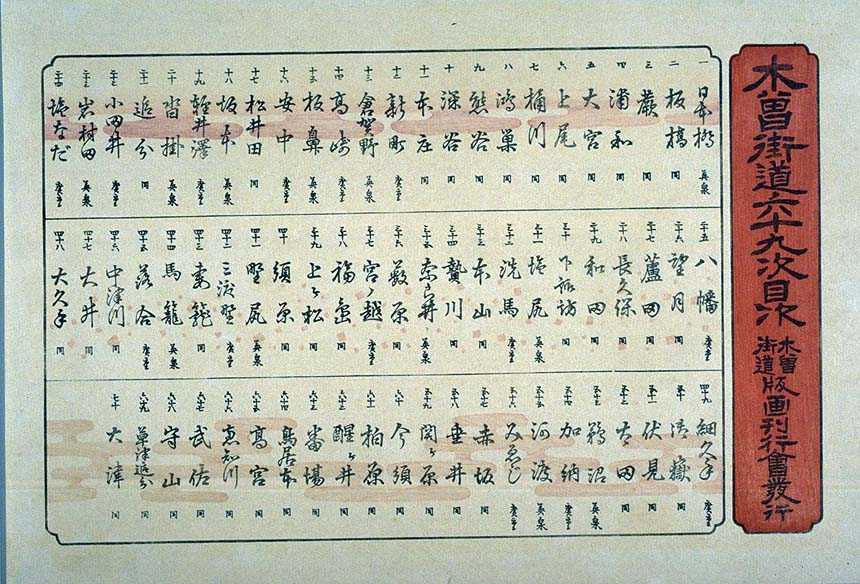
His beauties of the 1820s, many of them large-head portraits, replaced the grace and elegance of earlier ukiyo-e women with something more worldly: his women are self-assured, voluptuous and openly sensual. He also began the Sixty-nine Stations of the Kisokaido, one of the great landscape series, before Hiroshige took it over. And one of his courtesans, seen on a Paris magazine cover, became the model for a painting by Van Gogh.
What to buy
Originals: Eisen is underrated next to Kunisada and Kuniyoshi, which makes genuine Edo impressions of his beauties and landscapes a sensible buy; specialist dealers such as Fuji Arts carry them. The highest prices go to his Kisokaido designs. The Kisokaido was reissued by its later publisher after the first edition, so ask the dealer which edition a sheet is: the best dealers state the edition and describe the impression in detail. His output was large and uneven, so judge each design on its own. Condition decides value: faded colour, trimmed margins and repairs all cut it. Books: Taschen's Hiroshige & Eisen: The Sixty-Nine Stations along the Kisokaido, edited by Rhiannon Paget and Andreas Marks, reproduces the whole series from one of the finest surviving first editions and is the easiest way to see his landscapes beside Hiroshige's. Prints: the Art Institute of Chicago's large Eisen holding is online and a good source for a wall print.
Notes
The Art Institute of Chicago holds a wide range of his prints and illustrated books. He also wrote biographies of the Forty-seven Ronin and continued the Ukiyo-e ruiko, the early history of print designers, with a supplement titled "Notes of a Nameless Old Man".
Story
Eisen was not a respectable man, and did not pretend to be. The son of a samurai painter, he called himself a dissolute hard drinker, and he claimed that in the 1830s he had owned a brothel in the Nezu district of Edo, which burned down. He was also a serious chronicler of his trade, adding his own notes to the early history of print designers. Nearly forty years after his death, one of his courtesans reached Paris. In May 1886 the magazine Paris Illustre devoted an issue to Japan and put an Eisen print of a courtesan on the cover, reversed left to right. Vincent van Gogh copied the figure by tracing it on a grid, enlarged it, and in the autumn of 1887 painted her in bright colours against a yellow ground. He framed her with a pond of water lilies, bamboo, frogs and cranes. That border was a joke: in nineteenth-century France, prostitutes were often called grues, cranes, or grenouilles, frogs. The painting, Courtesan (after Eisen), is in the Van Gogh Museum in Amsterdam: the self-confessed brothel keeper's courtesan, reversed and in oils, had become a Van Gogh.
Key works
- Courtesan Stepping out of a Palanquin (early 1820s) - Art Institute of Chicago
- Cat Watching Goldfish (early 1820s) - Art Institute of Chicago
- Snow on the Sumida River (early 1830s) - Art Institute of Chicago
- Sixty-nine Stations of the Kisokaido (begun by Eisen, completed by Hiroshige) (from 1835) - series
- Rain on the Hiratsuka Plain near Kutsukake Station, from the Kisokaido series (c. 1835-1836) - Art Institute of Chicago
In museum collections
- No. 2, from the series Modern Versions of the Five Women (Tôsei gonin onna)
MFA Boston ↗ · Find a print ↗
See the work
Prints
Books
Originals
See also
Browse all 2,101 artists · Open in the directory · Where the work hangs: 17 museums on a map